No time to write much today but here's a video from the group at Rowan University:
The kite doesn't appear to be instrumented and I can't see a camera so i'd guess that the control is either passive or manual? I'll update this post if/when I find out.
On an ever so slightly larger scale, here's a video taken from a small airplane of a Skysails system in operation. The scale of the kite is seriously impressive. I'm not sure I realised how close-in the pod is kept to the kite. For some reason the kite is being flown at a higher angle than I would normally expect, maybe the ship is turning/tacking...
Either way, a glimpse of things to come I'm sure!
Monday, 13 September 2010


Thursday, 2 September 2010
Windlift Progress, new student project
Still have about 10k words to go on the thesis but the end is in sight and seeing as the wind hasn't picked up enough yet to go testing I thought it might be time for a quick post.
Here's a video showing the new prototype from Windlift, which is a departure from their old sled system to a reel based device. The test shows power peaking at 3kW at 8-12 mph though I'm not sure how high that wind measurement was taken or the size of the surf kite being used. Either way it shows some great progress over the last year. The base seems to be passively rotated and its inertia means that it's not following the direction of the kite too closely, (we had this same issue on a proto system here at Sussex) but it's not going to be too hard to sort that out.
I also found this website for a student project that I hadn't seen before at the Ecole Centrale de Lille, also for a kite based system. I saw this graphic of the system concept and was impressed to hear that they had built it.

This video shows it being tested. Having seen the scale, You can see how it was affordable as a student project! They have an interesting way of doing the steering at ground level.
Tuesday, 3 August 2010
3MW Kite generator in build ?!
World's most powerful kite turbine?
Just saw this video today featuring the Kitegen project on the Italian TV show 'Superquark'.
At about 2 mins 45 and 4 mins 50 you can see the system that featured in their last CGI animated visualisation in actual construction. Note that I actually have no idea if this actual build is supposed to be running a 3 MW generator, but this article on their website said that this was the case for the STEM concept.
Wow, at this point I should point out that Kitegen have been testing the largest capacity airborne wind energy system that I know of at 30kW for some years (data for auxiliary power generation capacity of the Skysails system is not available). They were the first commercial AWE project running if Skysails is discounted, and they have a considerable patent portfolio.
But... 30kw to 3000 would be an ambitious step. I'd love to know more about the motivation for the design concept, especially the rotating boom, which presumably would need active control, or at least damping to prevent its inertia taking it in an opposite direction to the kite at each extreme of the lying 8? Would a tower not be simpler? Also, it would be great to know what kite they are going to use, an 500sqm LEI doesn't seem particularly practical, and the L/D is not great. I guess we'll have to wait and see!
If any readers out there speak Italian and can glean more information from this than I have please enlighten us!
Sunday, 1 August 2010
Back to light entertainment, new Makani site, new companies, conference news
So after that painful exposuse to some math, here is something nice to look at, Makani's rather fetching new website . There's a new video I hadn't seen:
Which is nice to see, not sure what the wing area is, but you can see the power output and windspeed in the plot, if you managed to keep watching after that stomach churning on-board cam bit. I might do a post on the content of the new site at a later date.
Also here's a new company: Kitemill. I know not alot about this project but given the name I would expect ground generation with a kite? And another one : Altaeros Energies, who don't have a site yet but this article
shows a logo and the scheme of operation which is basically a windturbine elevated with a buoyant & lift generating, passively stable enclosure/fairing like this:

Final exciting news is that Jianjun Zhang of the snappily titled: Guangdong High-Altitude Wind Power Technology Ltd. will be at the AWE conference. I'm sure everyone is keen to hear about that project. Registration is open for the conference and I would definately recommend going. The list of speakers looks fantastic.
Ok ok, here's the last bit: Flygen vs Groundgen the finale
Has it really been 2 months? Sorry for the lack of updates, I have been desperately trying to bring my work together for my Dphil thesis which is due to be submitted in 53 days exactly and I'm still, hmm about 25k words and about 10 flight tests short!
Here is some of the ground gen/ flygen comparison brutally culled from my post on the awe list and from Loyd's wonderful paper.
Ok, some pros and cons. This is assuming that for a flygen you would have a hard wing and for a groundgen a soft wing. Uwe at TU Delft pointed out quite correctly that you can have a hard wing groundgen like that at Ampyx that will have some of the advantages (and disadvantages!) of both approaches.
After that, here are some gems from Loyd:

Basically this is saying that the power scales linearly with air density but with the cube of the apparent windspeed. Translation: Going fast is dispropotionately rewarded, when going high air will be thinner but this should be more than cancelled out by faster wind.
Next....Speed, and hence apparent wind speed is going to be affected by the lift/drag (glide) ratio of the wing, less drag meaning more speed. According to Loyds analysis this is another exponential effect - check it out here for the drag(flygen) mode, where:

This graph shows the exponential scaling showing how important efficient wings are. It looks linear but the scales are logarithmic ok!

This next graph shows that the peak power of the lift(groundgen,Fc) and drag(flygen,Fd) modes are pretty much the same. Groundgen reelspeed wants to be about 1/3 of windspeed, and there is a broad peak for the flygens in terms of the ammount of drag you put on the wing, which gives a fair bit of operational leeway.
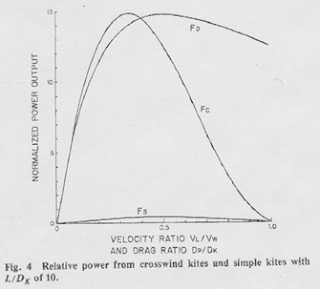
Now, Loyd does miss some things out for that comparison graph: tether drag: assuming that you have an unfaired ( a normal) tether, it will begin to dominate the drag of the system as your l/d on the wing gets higher and higher, so you won't see anything like the advantage shown by the graph.
Also Loyd assumed weightless wings.... why does this matter? Because during steering you are pulling the wing away from the direction it's is going, you will be using some of the energy from the wind for fighting the wings inertia. The heavier the wing the greater the loss.
Ok there ares a load of other things that could be incorporated to a model but that's enough for one day. So.. the conclusion is..... There is no clear winner, each approach has advantages and disadvantages, the 'best' solution won't neccesarily win the market, it will be a balance based on capital cost, performance, durability, safety, public acceptance, and more. In short, there's no free lunch.
Here is some of the ground gen/ flygen comparison brutally culled from my post on the awe list and from Loyd's wonderful paper.
Ok, some pros and cons. This is assuming that for a flygen you would have a hard wing and for a groundgen a soft wing. Uwe at TU Delft pointed out quite correctly that you can have a hard wing groundgen like that at Ampyx that will have some of the advantages (and disadvantages!) of both approaches.
| Soft | Hard |
| Harder to get high L/d | Easier to get high L/d |
| Lighter | Heavier - inertial loss? |
| Less prone to weight penalties on scaleup | More prone to weight penalties on scaleup |
| Cheap | Expensive |
| Subject to wear, esp when fluttering | Excellent wear characteristics |
| Under-actuated | Excellent control authority |
| Difficult and comp expensive to model- Multibody approach? | Can be modeled through conventional techniques, i.e.Neuton/Euler or Lagrangian in real time |
| Pack down small | Don't pack down |
| Could deform to match conditions | Must operate in all conditions |
| Can do ground gen | Must run power down cable |
| Severe cable wear from repetetive bending - if doing groundgen | Cable bending frequency is low - if doing flygen |
After that, here are some gems from Loyd:

Basically this is saying that the power scales linearly with air density but with the cube of the apparent windspeed. Translation: Going fast is dispropotionately rewarded, when going high air will be thinner but this should be more than cancelled out by faster wind.
Next....Speed, and hence apparent wind speed is going to be affected by the lift/drag (glide) ratio of the wing, less drag meaning more speed. According to Loyds analysis this is another exponential effect - check it out here for the drag(flygen) mode, where:

This graph shows the exponential scaling showing how important efficient wings are. It looks linear but the scales are logarithmic ok!

This next graph shows that the peak power of the lift(groundgen,Fc) and drag(flygen,Fd) modes are pretty much the same. Groundgen reelspeed wants to be about 1/3 of windspeed, and there is a broad peak for the flygens in terms of the ammount of drag you put on the wing, which gives a fair bit of operational leeway.

Now, Loyd does miss some things out for that comparison graph: tether drag: assuming that you have an unfaired ( a normal) tether, it will begin to dominate the drag of the system as your l/d on the wing gets higher and higher, so you won't see anything like the advantage shown by the graph.
Also Loyd assumed weightless wings.... why does this matter? Because during steering you are pulling the wing away from the direction it's is going, you will be using some of the energy from the wind for fighting the wings inertia. The heavier the wing the greater the loss.
Ok there ares a load of other things that could be incorporated to a model but that's enough for one day. So.. the conclusion is..... There is no clear winner, each approach has advantages and disadvantages, the 'best' solution won't neccesarily win the market, it will be a balance based on capital cost, performance, durability, safety, public acceptance, and more. In short, there's no free lunch.
Sunday, 30 May 2010
Groundgen/Flygen Comparison Weekend - 2
Ok, as promised, here is the second part, Flygen or 'Drag Mode' machines, here is a video that Corey of SwissKitePower pointed me to (thanks Corey!), featuring one of Makani Power's wings in much more detail than I had seen previously. Let get straight to it.
As you can see, they have moved well away from the fabric kite, groundgen approach they took at the start and the system now much more closely resembles a UAV. There is a strong dihedral, (the wings point up) on the horizontal stabilisers at the back there, and a lighter diherdral on the main wings. The 'fuselage' for want of a better word seems to be a large composite pole, I don't know if it really takes two people to lift it or if they are just being careful.
The next obvious video to post would be of Joby Energy's prototypes, but there are no embeddable videos up on youtube so you'll have to look here instead. There's a couple of nice video's of really agile free flight and self powered VTOL which I would assume is more scaleable than being shot into the air with compressed air, but what do I know?!....(edit 02/aug/10, makani's site now shows a full vtol concept with landing cradle, so clearly they are not planning on relying on the current scheme indefinitely!)
I'll do some basic comparison between the 2 approaches tomorrow, with a bit of reference to Loyd to bring it all together.
Saturday, 29 May 2010
Groundgen/Flygen Comparison Weekend - 1
Ground-generating Configuration Videos
Airborne wind energy is still in its infancy but I get the feeling that this difference is quite crucial and it will be really interesting to see how each stream matures over the next few years. Both schemes have some common benefits and challenges but also some very definate advantages and disadvantages. After I've shown both sets, I'll list a few of these as I see them and it would be really great to get some feedback from the surprisingly ever increasing number of readers.
The first video is Stefano Milanese from KitEnergy talking about some tests performed with their generator on a boat.
and here is a recent test from the laddermill team at TUdelft, they have a new website by the way at www.kitepower.eu. It shows them maxing out their generator at 20kW with a 25m SLE kite, there is also load of other interesting videos on the Laddermill Youtube channel so check them out.
Hopefully you readers will get impression of a growing maturity of kite energy, both in hardware and also operationally. Please note that TUDelft have air space authority for their testing at such altitudes - don't try that at home!
Sunday, 9 May 2010
2010 International Conference
Details of this year's Airborne Wind Energy conference, new consortium anounced
Sorry everyone for the terribly long wait since the last post, it has been all hands to the decks since February, having said that, there will be some exciting footage coming up soon.
The news today though is the details of the 2010 Airborne Wind Energy Conference (Let's not dwell on the retreat from high altitude shall we!) are out. Here is the link to the site: http://www.awec2010.com .
Key details:
- Conference Dates: Sept 29-30, 2010
- Conference Location: Stanford University, CA
- Submit speaker request by: (not explicit) ASAP
Subscribe to:
Posts (Atom)

About Me

- Allister Furey
- I finished my PhD on Evolutionary Robotics in Airborne Wind Energy applications in 2010. Since then I have been working in industry in the area.